
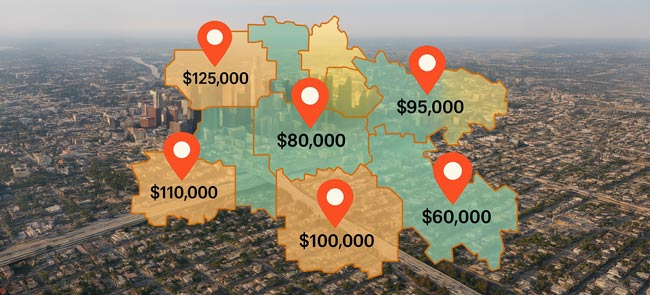
When you pay for inbound calls, wasting budget on the wrong neighborhoods hurts. Two ZIP codes may look identical on a map, but income data tells a very different story. A well-built zip code list, one based on median household income rather than guesswork, lets you target ZIP codes where people can actually afford your services.
That is the heart of this article: WHY income-driven targeting matters, WHY ZIP-code analysis reduces waste, and WHY every business using Pay-Per-Call should treat income data as a strategy object, not an afterthought.
Below, you’ll also see a few “quick questions” linked to the full FAQ section at the bottom.
Quick Answers (linked)
Why use income data when choosing ZIP codes?
Does targeting low-income areas reduce Pay-Per-Call ROI?
Where does ZIP-code income data come from?
Why Income Matters More Than Geography Alone.
Most companies choose service areas based on driving distance or population size. But that ignores the real-worldfactor that determines whether a caller converts: their ability to pay.
Two households in the same postal code can have different circumstances, but income average at the ZIP-code level still predicts conversion quality far better than radius targeting. This is why it’s so important to understand median household figures from reliable data sources such as the Census Bureau, the American Community Survey, and the annual social and economic supplement used to calculate money income across the country.
When you build a campaign using a zip-code list ranked by median incomes, you stop treating every ZIP code the same. Instead, you prioritize the ZIP codes where callers are statistically more capable of becoming paying customers.
When you pair income data with your Pay-Per-Call Services strategy on Pay-Per-Call Marketing with Pre-Screened Ready Customers, the result is a far more efficient service area plan that produces consistent, predictable caller quality.
This is how you avoid wasting call budgets in low-income areas with low close-rates, an issue many businesses overlook until it’s too late.
Income-Driven ZIP-Code Targeting vs. “Everyone Within 20 Miles”
Choosing ZIPs based on distance alone often guarantees poor distribution. A 20-mile targeting radius might capture:
A separate class of neighborhoods with extremely high incomes
Adjacent ZIPs with significantly lower incomes
Dense pockets of rural areas where spending patterns differ
Cities where the cost of living skews the meaning of “average”
Those boundaries have nothing to do with ability to convert.
If your call partner sends you traffic from a ZIP code with below-average money income, your cost per acquisition rises even if your cost per call never changes.
Income-based targeting gives you control, especially when your ad dollars are handled through Pay-Per-Call Servicesinside your broader Digital Marketing Services plan.
What Income Data Really Shows You (The “Why” Behind the Strategy)
Income levels tell you more than purchasing power. They also reveal:
Stability of people living in the area
Whether the neighborhood aligns with your offer price points
Which ZIPs consistently send you high-quality callers
Where call volume feels strong but conversions stay weak
It’s the difference between random lead-flow and code strategy that actually protects your budget.
Income differences across areas show up clearly in ACS income tables and other official U.S. Census Bureau income data, which is why ZIP-level income targeting can outperform simple radius targeting.
Those differences aren’t academic. They dictate whether your Pay-Per-Call spend produces profit or loss.
How to Build a Smart ZIP-Code Strategy (Without Overcomplicating It)
Although this article focuses primarily on WHY income-targeting matters, here’s a simple, actionable process:
- Pull a median household income dataset for your region using Census Bureau or ACS data.
- Sort every ZIP code from highest to lowest income average.
- Remove ZIPs with historically poor conversion performance.
- Expand or contract your service areas based on profitability, not map geometry.
- Send this income-ranked list to your call provider so they route only the ZIPs you want.
- This “income-first” framework works whether you run national Pay-Per-Call campaigns or smaller, regional ones.
| ZIP Code | City | State | Median Household Income | Notes |
|---|---|---|---|---|
| 90210 | Beverly Hills | CA | $116,787 | High-income ZIP; strong PPC potential |
| 90024 | Los Angeles | CA | $91,800 | Dense West Coast population; mid-high income |
| 78703 | Austin | TX | $121,671 | Affluent ZIP with consistent buyer intent |
| 33133 | Miami | FL | $103,174 | Coastal area with high conversion rates |
| 37215 | Nashville | TN | $149,720 | Top-tier income; excellent for Pay-Per-Call |
| 85054 | Phoenix | AZ | $92,200 | Growing, high-earning suburban ZIP |
What Does “Median Household Income” Mean, and Why It Matters
Median household income is the middle income value when households are ranked from lowest to highest. It’s a useful way to compare ZIP codes because it’s less distorted by extreme outliers than an average. For the full explanation of how this is calculated in census datasets, read What Median Household Income Means in Census Data.
A “household” includes all people who live together in a housing unit, whether they’re related or not, as long as they are of working-age (per thU.S. Census Bureau). Income counted is the total cash income of all those residents before taxes or deductions (wages, salaries, tips, self-employment income, investment income, benefits, etc.).
Why use the median rather than the average (mean)? Because averages can be skewed, a few very high-income households can pull the “average” artificial high. Median income, by contrast, gives a more realistic sense of what a “typical” household earns.
That makes MHI especially useful for evaluating and comparing different ZIP codes (or “postal code” areas). By looking at the median household income in a given ZIP code, you can get a realistic gauge of how much money people living there are likely to spend, without being biased by outliers at the high or very low end.
In short: “median household income” isn’t just a number, it’s a tool. It offers a clear, statistically-sound way to assess whether households in a ZIP code are likely to have the financial capacity to afford services. That’s why using MHI when choosing target zip codes helps reduce waste and improve conversion, you’re aiming for areas where the economic reality aligns with your ideal customer profile.
When a ZIP Code Is Worth Targeting
Service price: $5,000
Median household income: $125,000
A household earning $125k has enough financial margin to realistically purchase a $5k service without destabilizing their budget.
Even households slightly below the median in this ZIP code likely still have enough income flexibility to pay for high-ticket services, especially urgent or necessary services.
Why this ZIP is worth targeting:
- These households may have savings or disposable income.
- They are accustomed to spending on maintenance, renovations, repairs, and quality services.
- A $5k purchase represents 4% of annual income, which is manageable.
- Marketing dollars are more efficient because the audience has both need and ability to pay.
This is what a good code strategy looks like, choosing target ZIP codes where the median household income supports your service price.
Example: When a ZIP Code Is Not Worth Targeting
Service price: $5,000
Median household income: $50,000
A household earning $50k is often already stretched. After taxes, insurance, food, transportation, rent/mortgage, and basic living costs, there’s very little room left.
For a family at this income level, a $5k service is not only a large unexpected expense, it is often simply not possible without loans, financing, or delaying essential bills.
Why this ZIP is not worth targeting:
- A $5k purchase represents 10% of their entire annual income.
- These households are extremely price-sensitive.
- Lead quality drops because even if they need the service, they can’t realistically afford it.
- Your ad spend goes toward people who will never convert, this is the definition of wasted budget.
This is how low-income areas quietly drain marketing ROI: the need exists, but the economic ability does not.
Income-based ZIP selection should be part of your Digital Marketing Services strategy, whether you’re optimizing for paid leads, Pay-Per-Call, or long-term local SEO.
ZIP-Code Affordability Calculator
Enter your service price and the median household income for the ZIP code to see how realistic it is to sell that service in that area.
Bottom Line
If your service costs $5,000, and the median household income in a ZIP code is only $50,000, the math tells you everything you need to know:
✔ You can generate calls.
✘ But very few will convert.
A ZIP code list based on income average is not about excluding people.
It’s about ensuring your marketing dollars reach households that can actually afford what you sell
FAQ
1. Why should ZIP codes be selected using income data?
Income-first targeting gives you stronger conversion potential. Higher median household income correlates with higher purchasing ability, which makes your Pay-Per-Call campaigns more profitable.
2. Do low-income areas hurt Pay-Per-Call results?
Not always—but low-income areas tend to produce more price objections and lower close-rates. This is why code strategy matters.
3. Where does ZIP-code income data come from?
Most data sources come from the Census Bureau, population survey, and the annual social and economic supplement, which calculates money income across every ZIP code.
4. How do I start implementing this strategy?
Begin by building a ZIP-code list, sorted by median incomes, then share it with your call provider or integrate it into your routing rules through your Pay-Per-Call Services.
Want help building an optimized ZIP-code income list?
We can evaluate income average, your service areas, and call quality to create a real-world, data-driven ZIP-code map tailored to your business services and pricing.
Turn Why Choosing ZIP Codes by Income for Better Pay-Per-Call Results into a clearer next step
Why Choosing ZIP Codes by Income for Better Pay-Per-Call Results becomes more useful when the takeaway is connected to Pay Per Call, website clarity, and measurable lead quality. PX Media can turn Why Choosing ZIP Codes by Income for Better Pay-Per-Call Results into a practical review of call sources, intake criteria, campaign geography, lead quality, budgets, and follow-up process so the next move supports the business instead of adding more noise.
Pay-Per-Call: Pre-Screened Ready Customers on the Line
Why Choosing ZIP Codes by Income for Better Pay-Per-Call Results pairs well with Pay-Per-Call: Pre-Screened Ready Customers on the Line when you want a clearer next move before changing campaigns, design, or measurement.
Pasadena Pay Per Call Marketing Services
Pasadena Pay Per Call Marketing Services gives Why Choosing ZIP Codes by Income for Better Pay-Per-Call Results a stronger follow-through path for planning, service review, and practical action.
Local Digital Marketing Agency
Local Digital Marketing Agency can connect the ideas around Why Choosing ZIP Codes by Income for Better Pay-Per-Call Results with a more focused service conversation.
Blog & Press
Why Choosing ZIP Codes by Income for Better Pay-Per-Call Results often leads into Blog & Press when the goal is better clarity, cleaner tracking, or stronger lead quality.
Talk To Us
Talk To Us can help turn the takeaways from Why Choosing ZIP Codes by Income for Better Pay-Per-Call Results into a more specific plan for your business.
Questions that come up after Why Choosing ZIP Codes by Income for Better Pay-Per-Call Results
How does Why Choosing ZIP Codes by Income for Better Pay-Per-Call Results fit into a practical Pay Per Call plan?
Why Choosing ZIP Codes by Income for Better Pay-Per-Call Results can help clarify where Pay Per Call needs more attention, especially around call quality, source tracking, intake fit, budget control, and service-area targeting. With Why Choosing ZIP Codes by Income for Better Pay-Per-Call Results as the starting point, PX Media shapes next steps that are easier to measure and easier for visitors to act on.
What should a business review before acting on Why Choosing ZIP Codes by Income for Better Pay-Per-Call Results?
Before making changes after Why Choosing ZIP Codes by Income for Better Pay-Per-Call Results, it helps to review call sources, intake criteria, campaign geography, lead quality, budgets, and follow-up process. That keeps decisions around Why Choosing ZIP Codes by Income for Better Pay-Per-Call Results grounded in real visitor behavior, lead quality, and the business outcome that matters most.
When is it worth asking PX Media for help after Why Choosing ZIP Codes by Income for Better Pay-Per-Call Results?
It is worth asking for help when the issue behind Why Choosing ZIP Codes by Income for Better Pay-Per-Call Results feels scattered, hard to measure, or disconnected from qualified inquiries. PX Media can review the current setup and help turn Why Choosing ZIP Codes by Income for Better Pay-Per-Call Results into a clearer action plan.
Need help applying Why Choosing ZIP Codes by Income for Better Pay-Per-Call Results?
PX Media can review the current setup behind Why Choosing ZIP Codes by Income for Better Pay-Per-Call Results, clarify the strongest opportunity, and connect Pay Per Call with a cleaner plan for visibility, conversion, and follow-up.